
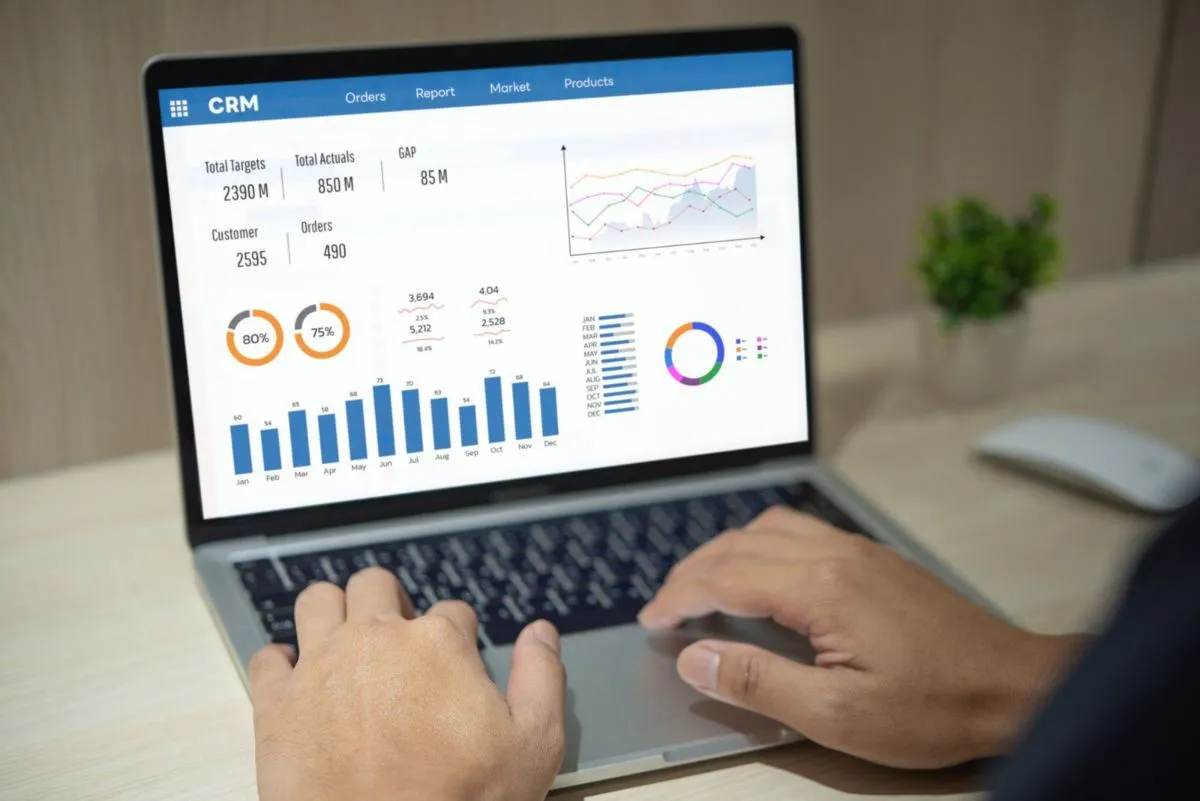
Bespoke development gives you an exact fit and a system to maintain for years. A configured all-in-one CRM is live in weeks but bends to its platform. Here is how to choose.
Written by the Sharktech Global team. Published 30 October 2026.
Who is this decision for?
Almost every Australian business. There were 2,656,469 small businesses in June 2025, 97.3 percent of all businesses, counting those with fewer than 20 employees (ASBFEO, from ABS data, August 2025). Most have no IT team, and that shapes the answer.
This guide comes from Sharktech Global, which builds and runs Launch Your Dream.ai, its business suite for Australian small and medium businesses. We sell the configured option, so we have tried to be fair about when it is the wrong one.
What is the difference between a custom CRM vs an off-the-shelf CRM?
Configured software is an existing CRM set up for your business: pipeline stages, custom fields, forms, automations and templates. You rent it, the provider maintains it, and you change it through settings.
Bespoke development is new code written for your process. You usually own it, and you also own hosting, security patches, bug fixes and every future change.
Plenty of businesses sit in between: a configured CRM plus one custom integration to a system the CRM does not know.
How do the two approaches compare?
| Factor | Custom CRM development | Configured all-in-one CRM |
|---|---|---|
| Fit to process | Exact | Close, through settings |
| Time to go live | Months: discovery, build, testing | Days to weeks |
| Upfront cost | A development project | Setup plus a monthly plan |
| Ongoing cost | Hosting, patches, fixes, new features | Included in the plan |
| Maintenance | Your developer, indefinitely | The platform provider |
| Ownership | Usually yours; check the contract | You rent the software and own your data |
| Portability | Depends on how it was built | Depends on export options |
| Integrations | Built one by one | A catalogue, plus custom work where needed |
| Implementation effort | High for you and the builder | Moderate: decisions, data and training |
When does custom development make sense?
When at least three of these are true:
- Your core process cannot be expressed as pipeline stages and fields.
- You must connect deeply to a proprietary system, such as your own dispatch software.
- You have a budget for continuous development, not one project.
- Someone in the business will own the developer relationship for years.
Fewer than three, and bespoke usually costs more and arrives later.
What do the running costs look like?
Price CRM implementation for a small business over three years, not at launch. For the configured route, VCPility, the platform under Launch Your Dream.ai, has plans from A$50 a month plus GST, with custom integrations at A$500 one-off (VCPility plans, read 30 October 2026). Industry suites are priced in a written proposal before you sign.
For bespoke work, add hosting, monitoring, security updates and a realistic monthly allowance for changes. Ask the developer for that figure in writing.
What should you check before choosing either?
- CRM migration. Who moves your existing contacts, how are duplicates handled, and what history comes across? A clean spreadsheet migrates far more easily than a messy one.
- CRM integrations. List the tools it must talk to: accounting, calendar, payments, ad lead forms. Check each one by name.
- Portability. Confirm you can export everything in a standard format.
- Privacy. Most businesses with annual turnover of $3 million or less are not covered by the Privacy Act, but health service providers and several other groups are, whatever their size (OAIC). Check where data is hosted against your obligations.
- Messaging rules. Email and SMS features must support consent records and a working unsubscribe for commercial messages under the Spam Act 2003.
- Training. A CRM nobody uses is a cost. Confirm who trains the team.
A worked example
Take a hypothetical solar installer in Wollongong with three staff. Enquiries arrive from the website, Facebook lead ads and missed calls. Quotes go out by email and are followed up when someone remembers. Nothing about that process is unusual, so a configured CRM with quote follow-up and lead ad capture fits it. If the same installer also ran a proprietary monitoring platform that had to trigger service jobs, a custom integration would be worth scoping. That would be an addition, not a rebuild.
How Sharktech Global approaches CRM
Launch Your Dream.ai, the business-suite product from Sharktech Global, is a configured all-in-one CRM with the website, AI assistant, booking and follow-up connected from day one. Our CRM setup service covers configuration for your industry and team training, and the CRM for small business guide explains what is included. To test your process against both options, book a free 30-minute discovery call. For the wider job of running enquiries, bookings and follow-up, see business management software for Australian small business.
Common questions
- Is configuring a CRM the same as custom development?
- No. Configuration sets up pipelines, fields, automations and forms inside existing software. Custom development writes new code, which you then own, host and maintain.
- How long does setup take?
- A configured system can be live in days or weeks. Launch Your Dream.ai suites go live within 60 minutes of setting up billing. Bespoke builds usually take months.
- Can I take my data with me if I leave?
- Ask before you sign. Confirm you can export contacts, notes and history in a standard format such as CSV.
- Does the Privacy Act apply to my CRM?
- It depends. Most businesses with annual turnover of $3 million or less are exempt, but health service providers and several other groups are covered regardless.
- Who built Launch Your Dream?
- Launch Your Dream is built and supported by Sharktech Global (opens in a new tab), an Australian managed IT and AI agent deployment company serving NSW and regional NSW.